

Reviewed · TICKETS
Entrance Ticket to World of Seashells museum
Shells can tell surprisingly big stories. At Chamarel’s World of Seashells Museum, an $7 ticket opens the door to 8,000 shells from around the world, displayed with explanations about biology, culture, myths, and mathematics. I like the beautiful presentation, and I like that the museum gives you more than a room full of pretty objects.
The main consideration is time. The official visit takes about 45 minutes to 1 hour 30 minutes, but some people finish in 20 to 30 minutes. If you have a short attention span, the large number of displays may feel repetitive, and you should plan your timing carefully because one afternoon visitor arrived before the stated 3 p.m. last entry but found the museum closed.
In This Review
- Key points to know before you go
- Entering Chamarel’s shell collection
- What the 8,000 shells reveal
- Patterns, colors, and the shell theorem
- Shells in myths and daily life
- Why children may enjoy the stop
- How long to allow at World of Seashells
- Is $7 a fair price?
- Practical planning for your visit
- Who should book this museum?
- Should you book World of Seashells?
- FAQ
- Where is World of Seashells Museum located?
- How much does admission cost?
- How long does the visit take?
- What time does the experience start?
- What is included with the ticket?
- Is the ticket available on a mobile phone?
- Can I cancel for a full refund?
- What happens if bad weather cancels the experience?
Key points to know before you go
- 8,000 shells in one collection: You will see specimens gathered from many countries, with a strong focus on variety, form, and color.
- More than a display of beach finds: Explanations cover shell structure, animal life, defense systems, cultural uses, myths, and the shell theorem.
- A good stop in Chamarel: The museum fits well into a day exploring the southern part of Mauritius.
- A useful family activity: Children can enjoy the colors and unusual shapes while learning why shells matter to marine ecosystems.
- Allow 45 to 90 minutes: The experience can be shorter if you move quickly, but the labels reward a slower look.
- Good value at $7 per person: The modest admission price makes this an easy add-on if you are already in the area.
Entering Chamarel’s shell collection
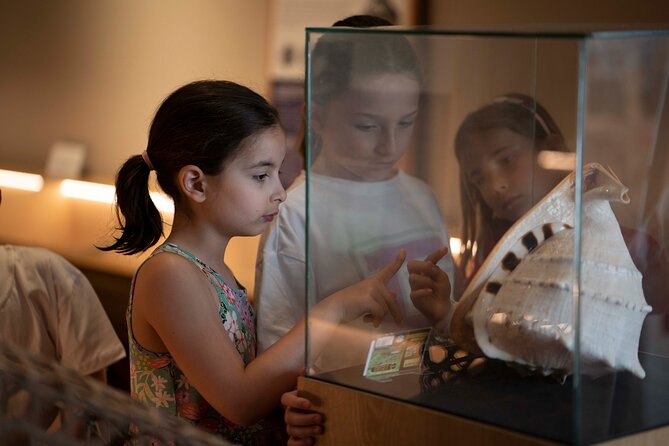
World of Seashells is in Chamarel, a well-known stop in southern Mauritius. The attraction is simple in concept: you enter a museum devoted to shells, then work through a large collection arranged to show how varied these natural forms can be.
That simplicity is part of its appeal. You do not need a special interest in marine biology to enjoy the first few displays. Shapes range from smooth and rounded to sharply ridged, tightly coiled, heavily patterned, or almost sculptural. The color range also gives the collection much of its visual pull.
I like that this is not presented as a random pile of souvenirs. The displays are organized, labeled, and designed to explain what you are seeing. One shell may catch your eye because of its color, while the accompanying information explains its structure or the creature that once lived inside it.
The collection is described as the largest seashell collection in Africa. That gives the museum a clear sense of place and purpose, rather than making it feel like a general gift shop display. You are seeing a substantial international collection in Mauritius, not only shells collected from nearby beaches.
A few more Chamarel trips worth lining up side by side
- North Day Tour, Botanical Garden, Sugar Museum, Rum Tasting
★ 5.0 · 3 reviews
What the 8,000 shells reveal

The first major theme is morphology, or the physical structure of shells. You learn how shells grow, why their shapes differ, and how their patterns are connected to the animals that make them.
This is useful because shells can look decorative when they are removed from their natural setting. The museum helps you see them as working parts of living creatures. Their shape, thickness, opening, ridges, and color all have a purpose, even if that purpose is not obvious at first glance.
The displays also explain living mechanisms. You may find information about how shellfish grow and how their shells protect them. The collection’s value is not only in its size, but in the way it connects appearance with function.
Another section focuses on defense systems. A shell is a home and a shield, and its form can help an animal resist predators or survive its surroundings. That gives the displays a practical angle. You are not simply asking which shell is prettiest. You begin asking why it developed that way.
The museum also links shells to the environment. This is one of the strongest reasons to read the information rather than simply walk past the cases. Shells are part of marine ecosystems, and the explanations help show why these small objects matter beyond their decorative use.
Patterns, colors, and the shell theorem
The visual display is likely to be the museum’s quickest reward. The shells are described as beautifully presented, with careful attention to their patterns and colors. For many people, this will be the part that makes the $7 admission feel worthwhile almost immediately.
Some shells have delicate markings. Others rely on strong spirals, ridges, or unusual proportions. Seen together, the collection shows how nature can repeat certain forms while producing endless variations.
The museum also introduces the shell theorem and the mathematical basis of spiral curves. You do not need a mathematics background to appreciate this section. It offers a different way to look at the collection, turning a familiar spiral into a question about growth, proportion, and natural design.
I especially like this change of viewpoint. A child may see a perfect spiral as a cool shape. An adult may begin thinking about geometry. Both responses work, and the museum does not require you to treat the subject like a formal class.
Still, you should set your expectations correctly. This is a self-guided museum visit based on displays and written information, not a long guided lecture. If you enjoy stopping to read, you can spend close to the full 45 to 90 minutes. If you mainly want a quick look at unusual shells, your visit may be much shorter.
Shells in myths and daily life
The museum moves beyond science to explore how people have used shells across centuries. This gives the collection a human side and helps explain why shells appear in stories, symbols, tools, and traditions around the world.
You will also encounter myths and legends connected by the idea that the shell symbolizes the origin of life. The exact stories are part of the museum’s interpretive material, but the wider point is clear: shells have carried meaning far beyond the shoreline.
This cultural angle makes the visit more rewarding than a basic identification display. A shell can be a biological structure, a mathematical form, an environmental object, and a symbol. The museum brings those themes together in one place.
I would encourage you to slow down at these sections. The visual displays may draw you forward quickly, but the cultural information gives the visit its depth. It is also where the museum works best for mixed groups. One person can focus on the shell shapes, while another reads about how different cultures viewed or used them.
That said, the amount of written information may not suit everyone. If you prefer a fast-moving attraction, several thousand labeled specimens can feel like a lot. This is a place for small discoveries rather than one dramatic highlight.
Still Mauritius, just a completely different sort of day:
- Mauritius: Private South Tour with Pickup
★ 4.9 · 940 reviews - Full-Day Catamaran Cruise to Île aux Cerfs with BBQ Lunch
★ 4.5 · 455 reviews - Mauritius: Private Southwest Day Tour
★ 4.8 · 312 reviews - Mauritius: Chamarel 7 Colours & Waterfalls, South-West Tour
★ 4.6 · 287 reviews
Why children may enjoy the stop
The museum is promoted as an experience that can captivate children, and that makes sense. Shells offer an easy starting point for curiosity because they are tangible, colorful, and full of odd shapes.
Young children may be drawn to the specimens that look unlike anything they have seen on a beach. Older children can follow the explanations about protection, growth, animal life, and ecosystems. The shell theorem adds a simple connection to mathematics without requiring a separate classroom lesson.
For families, the museum also provides a calmer change of pace. A visit here does not depend on physical exertion, long travel between stops, or a complex activity schedule. You can move at your own pace and decide how much reading suits your group.
I would not promise that every child will stay engaged for the entire visit. The collection contains thousands of pieces, and children with short attention spans may enjoy the first displays more than the later ones. A shorter visit can still work well, especially if you point out unusual forms and let children choose their favorite shells.
The museum is also useful for adults who want to give a young person more context about the sea. Instead of simply saying do not take shells from the beach, you can talk about the animals that make them and the part they play in the environment.
How long to allow at World of Seashells
The stated visit length is approximately 45 minutes to 1 hour 30 minutes. That is a sensible range if you want time to look closely and read the explanations.
Some visitors have completed the museum in 20 to 30 minutes. That shorter timing is possible if you move through the displays quickly or focus mainly on the visual collection. I would allow at least 45 minutes in your schedule so you do not feel rushed.
If you are combining the museum with other Chamarel stops, this timing matters. It is short enough to fit into a busy sightseeing day, but long enough that you should not treat it as a five-minute photo stop.
The start time supplied for the experience is 9 a.m. The information also notes a 3 p.m. last entry. Because one visitor found the museum closed at 2:40 p.m. despite knocking, I would avoid arriving near the end of the day. Plan for an earlier visit and allow some margin.
The experience requires good weather. That condition may seem surprising for a museum, but it is part of the booking terms. If poor weather causes cancellation, you can be offered another date or a full refund.
Is $7 a fair price?
At $7 per person, this is an inexpensive attraction by sightseeing standards. The value depends on how much you enjoy looking closely and reading, but the size of the collection gives the ticket a strong case.
You are not paying for a long excursion, transport, or a full-day program. You are paying for access to a specialized museum with 8,000 specimens and information covering natural science, culture, mathematics, and environmental value.
I see it as especially good value if you are already spending time in Chamarel. The museum can fill a useful portion of the day without creating a major cost. It also gives you an indoor stop among outdoor sightseeing activities.
The value is weaker if you expect an interactive attraction or a guided presentation. The experience is built around viewing displays, reading, and making your own way through the collection. People who love shell collecting or the sea are likely to spend more time here than people who only want a quick photograph.
The museum has an overall rating of 4.3 from seven published ratings, which suggests a generally positive response but is not a large enough sample to remove all uncertainty. The praise focuses on the beauty of the displays, the surprising variety, and the amount of information provided.
Practical planning for your visit

The ticket is mobile, so you can keep the admission details on your phone. Confirmation is received at booking, which makes the process straightforward.
The museum is near public transportation, and service animals are allowed. Most people can participate, according to the available information. No special physical ability is identified as necessary.
I would book ahead if your schedule is fixed. The experience is booked about five days in advance on average, so it is not only a last-minute stop for everyone. Booking early also gives you more flexibility around your Chamarel plans.
Free cancellation is available if you cancel at least 24 hours before the start time. Cancellations or changes made less than 24 hours before the start are not refunded, and late changes are not accepted. Keep the local time in mind when calculating the deadline.
For the best visit, arrive well before the stated 3 p.m. last entry, keep your phone charged for the mobile ticket, and leave enough time to read. If you are visiting with children, you may want to treat the museum as a focused 30 to 45 minute activity rather than promising a full hour and a half.
Who should book this museum?
I would recommend World of Seashells to anyone already visiting southern Mauritius, especially if you enjoy nature displays, collecting, marine life, or small museums with a clear theme.
It is a particularly good match for families. The colors and shapes give children something immediate to look at, while the information about animals, protection, culture, and ecosystems gives adults a reason to stay longer.
Shell hunters and beachcombers may find the collection especially satisfying. The variety is the main attraction, and the displays give you a chance to compare shells from different parts of the world rather than seeing only the few types found locally.
You may want to skip it if you dislike reading displays or prefer highly active attractions. Several thousand shells can feel repetitive if you are not interested in their differences. The museum is also not a substitute for a beach, boat trip, or wildlife experience. It is a quiet, focused look at one subject.
Should you book World of Seashells?
Book it if you are in Chamarel and want an affordable, unusual stop with real educational value. The collection is large, the price is low, and the subject reaches into biology, mathematics, culture, and environmental care.
Give yourself at least 45 minutes, arrive early in the day, and do not leave it until the final afternoon entry. If you expect a fast, interactive attraction, keep your visit brief. If shells fascinate you, the displays may hold your attention much longer than expected.
FAQ
Where is World of Seashells Museum located?
The museum is located in Chamarel, Mauritius.
How much does admission cost?
The entrance ticket costs $7 per person.
How long does the visit take?
The approximate visit lasts from 45 minutes to 1 hour 30 minutes. Some people complete it in 20 to 30 minutes.
What time does the experience start?
The listed start time is 9 a.m.
What is included with the ticket?
Admission to World of Seashells Museum is included.
Is the ticket available on a mobile phone?
Yes. The experience provides a mobile ticket.
Can I cancel for a full refund?
Yes, if you cancel at least 24 hours before the experience start time. Cancellations made less than 24 hours before the start are not refunded.
What happens if bad weather cancels the experience?
You will be offered a different date or a full refund if poor weather causes the experience to be canceled.
Recently added around Chamarel
- Taxi Mauritius Airport Transfers★ 5.0 · 11 reviews
- Set Sail on an All Inclusive Catamaran to Ile Aux Benitiers★ 3.0 · 2 reviews
- All inclusive SPEEDBOAT FULL DAY to ILE AUX CERF & GRSE WATERFALL★ 4.0 · 12 reviews
- Fascinating Nature Tour Incl Ebony Forest, 7 Coloured Earth,Lunch★ 5.0 · 3 reviews
- Fully Day Tour: Dolphin Encounters, Crystal Rock at Benitiers Island★ 4.0 · 13 reviews
- Mauritius: Sunrise Mountain Hike with Southwest Road-trip★ 5.0 · 10 reviews
- Mauritius: Private Southwest Tour with Pickup★ 5.0 · 8 reviews
- Mauritius: Private South Side and Dolphin Adventure Tour★ 5.0 · 11 reviews
Tickets, compared.


Ticket to the largest Oceanarium of the Mascarene Islands
Read our review →
Casela Nature Parks Entrance Ticket with Transfer
Read our review →
Private Full Day Tour with Entry Tickets & Lunch
Read our review →
Browse the lists this tour appears in